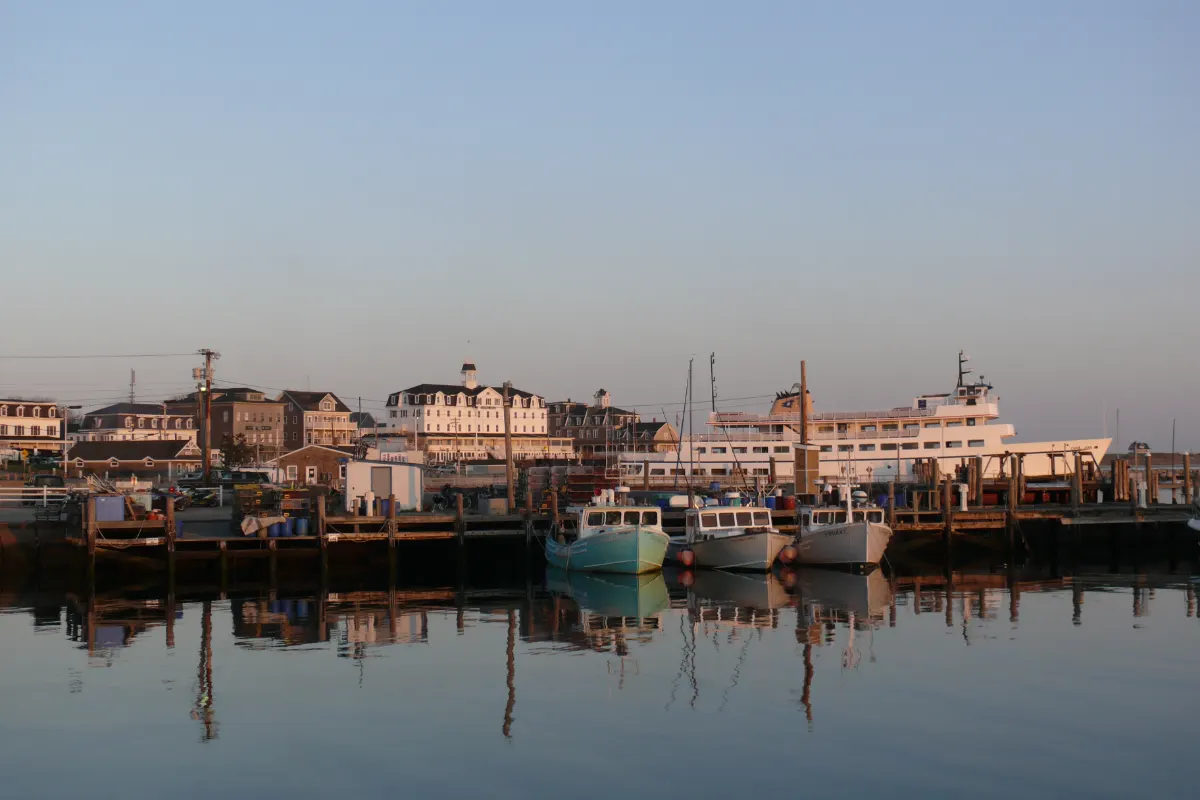
New Shoreham's Wastewater Management Program rules
New Shoreham's Wastewater Management Program rests on Town Code Chapter 19, Article IV, and Zoning Section 506. Under the code, every onsite system is inspected at least once every three years, and a tank must be pumped within 30 days of notice once sludge plus scum reaches 25 to 33 percent of capacity.
Enforcement is spelled out: after a second notice, fines can reach $100 a day, and after a Town Council hearing, up to $500 per violation. The program is administered by the Director of Public Works, with the inspector based at 16 Old Town Road. See septic inspections and septic pumping.
This is general information, not legal or tax advice.
Inside or outside the Block Island sewer district
The sewer district covers all of Old Harbor and New Harbor as far west as Champlin's Marina, plus the Spring House, the Block Island School, the Medical Center, Town Hall, and Corn Neck Road as far as the Beach Head. Outside those areas, properties use onsite systems under the town program.
The plant dates to 1978 and was upgraded in 2008, with over 3.5 miles of sewer and 5 pump stations. RIDEM's facility profile lists a 0.3 MGD design at 252 Spring Street, serving about 300 to 700 customers in winter and about 4,000 in summer. For a hookup inside the district, see sewer connection.
Why the island's aquifer drives every septic rule
EPA designated the Block Island Sole Source Aquifer on January 24, 1984. It is a glacial sand and gravel aquifer with no alternative drinking-water source, and EPA named septic tanks as a contamination risk. The town cites protecting it as the reason for its wastewater program.
Zoning sets treatment standards by location and soil conditions, so two lots a mile apart can need different systems. Unlike Westerly and the other mainland pond towns, the island is not in RIDEM's Salt Pond area; Great Salt Pond is not on that list. Site-specific septic design and soil testing settles what a lot needs.
Rentals, effluent filters and the summer surge
Block Island grows from about 1,000 year-round residents to more than 20,000 in summer, and septic rules reflect it. Rental properties must clean effluent filters every year. The town page describes a biannual schedule for other properties, which we read as every two years; confirm with the inspector.
The code also flags a change of use: converting a seasonal house to year-round occupancy triggers review. If you plan to rent out a home or live in it through winter, have the system evaluated first, since a bigger load on a small tank or field can turn a passing system into a failing one.
Scheduling septic work around the Point Judith ferry
Equipment and materials for island septic work generally arrive by boat from Point Judith in Narragansett, roughly an hour on the traditional car ferry. RIDEM notes that boats stop running about 72 hours before major storms, which is why the sewer plant stockpiles supplies.
Plan extra time into any project. Groundwater readings follow RIDEM's January 1 to April 1 wet-season window, so a design started in fall may not be buildable until late spring. Our wet season water table testing guide explains the timing.
Block Island cesspools and loan help
RIDEM's 2022 summary calls the island's town-wide cesspool phase-out ongoing, though we found no fixed deadline in the code. The state sale rule still applies: a cesspool must be removed from service within one year of closing. See cesspool replacement and our Rhode Island cesspool law page.
New Shoreham offers both the state septic loan program (CSSLP) and a Sewer Tie-In Loan Fund; RIHousing describes tie-in loans of up to $10,000 over up to 5 years. RIIB's plan sets septic loan cost at 1% annually plus $300 upfront, for up to 10 years. Confirm with the town or RIHousing, read the RI septic loan program guide, compare other service areas, or reach us at 401-535-7951 for a free estimate.
This is general information, not legal or tax advice.
Block Island septic questions
How often do Block Island septic systems need inspection?
Every three years at minimum, per Town Code Chapter 19, Article IV. If the inspection shows sludge and scum at 25 to 33 percent of tank capacity, the tank must be pumped within 30 days of notice. Repeated noncompliance can bring fines of up to $100 a day after a second notice.
Do Block Island rentals have extra septic rules?
Yes. Rental properties must have their effluent filters cleaned every year, more often than other homes, because summer occupancy swells the island from about 1,000 people to more than 20,000. Converting a seasonal home to year-round use also triggers a review under the town code. See the town program page.
Does Great Salt Pond fall under the salt pond nitrogen rules?
No. RIDEM's Salt Pond critical resource area covers ponds in Charlestown, Narragansett, South Kingstown and Westerly, and Block Island's Great Salt Pond is not on that list. The island instead sets treatment standards through its own zoning, based on location and soils, to protect the sole source aquifer.
Is there a deadline to replace a Block Island cesspool?
We found no fixed local deadline, though RIDEM describes the town's phase-out as ongoing. The state rule applies at sale: the cesspool has to be out of service within a year of closing. A failed cesspool must also be abandoned within one year of discovery under state law.